Search w3schools.com:

SHARE THIS PAGE

HTML5 Introduction


HTML5 is The New HTML Standard

HTML5

  • New Elements
  • New Attributes
  • Full CSS3 Support
  • Video and Audio
  • 2D/3D Graphics
  • Local Storage
  • Local SQL Database
  • Web Applications

Examples in Each Chapter

With our HTML editor, you can edit the HTML, and click on a button to view the result.

Example

<!DOCTYPE HTML>
<html>
<body>

<video width="320" height="240" controls>
  <source src="movie.mp4" type="video/mp4">
  <source src="movie.ogg" type="video/ogg">
  Your browser does not support the video tag.
</video>

</body>
</html>

Try it yourself »

Click on the "Try it yourself" button to see how it works


What is HTML5?

HTML5 will be the new standard for HTML.

The previous version of HTML, HTML 4.01, came in 1999. The web has changed a lot since then.

HTML5 is still a work in progress. However, the major browsers support many of the new HTML5 elements and APIs.


How Did HTML5 Get Started?

HTML5 is a cooperation between the World Wide Web Consortium (W3C) and the Web Hypertext Application Technology Working Group (WHATWG).

WHATWG was working with web forms and applications, and W3C was working with XHTML 2.0. In 2006, they decided to cooperate and create a new version of HTML.

Some rules for HTML5 were established:

  • New features should be based on HTML, CSS, DOM, and JavaScript
  • Reduce the need for external plugins (like Flash)
  • Better error handling
  • More markup to replace scripting
  • HTML5 should be device independent
  • The development process should be visible to the public

The HTML5 <!DOCTYPE>

In HTML5 there is only one <!doctype> declaration, and it is very simple:

<!DOCTYPE html>


Minimum HTML5 Document

Below is a simple HTML5 document, with the minimum of required tags:

<!DOCTYPE html>
<html>
<head>
<title>Title of the document</title>
</head>

<body>
The content of the document......
</body>

</html>


HTML5 - New Features

Some of the most interesting new features in HTML5:

  • The <canvas> element for 2D drawing
  • The <video> and <audio> elements for media playback
  • Support for local storage
  • New content-specific elements, like <article>, <footer>, <header>, <nav>, <section>
  • New form controls, like calendar, date, time, email, url, search

Browser Support for HTML5

HTML5 is not yet an official standard, and no browsers have full HTML5 support.

But all major browsers (Safari, Chrome, Firefox, Opera, Internet Explorer) continue to add new HTML5 features to their latest versions.


HTML5 References

At W3Schools you will find complete references about tags, global attributes, standard events, and more.

HTML5 Reference


W3Schools Certification

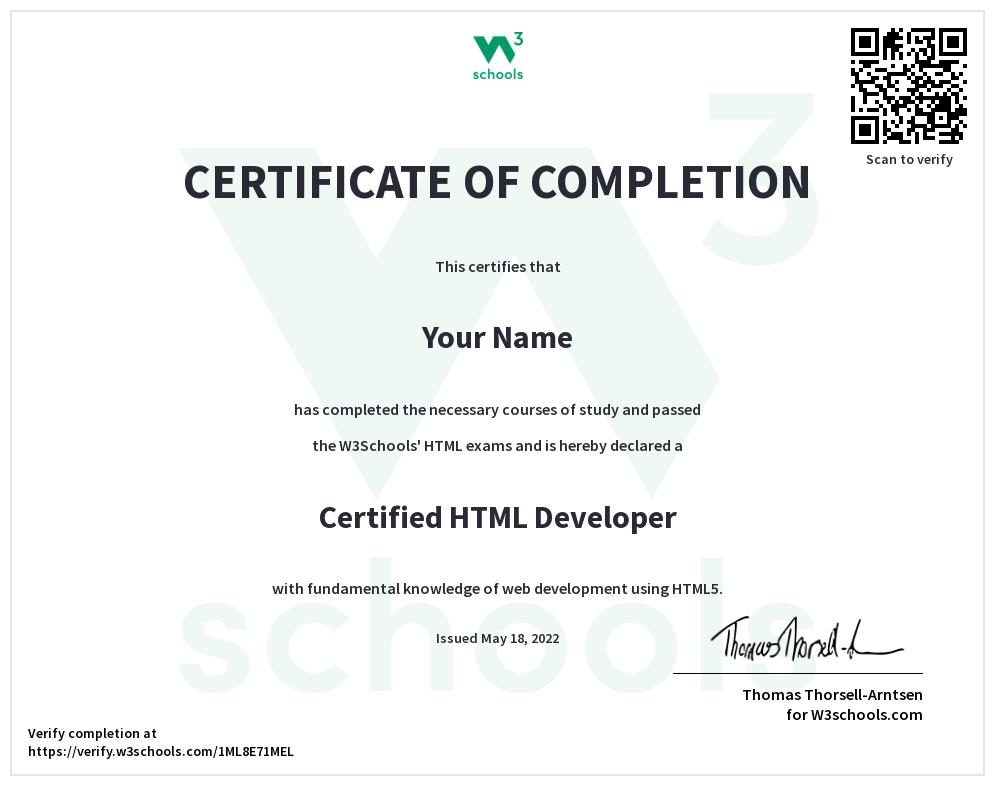
W3Schools' Online Certification

The perfect solution for professionals who need to balance work, family, and career building.

More than 10 000 certificates already issued!

Get Your Certificate »

The HTML Certificate documents your knowledge of HTML.

The HTML5 Certificate documents your knowledge of advanced HTML5.

The CSS Certificate documents your knowledge of advanced CSS.

The JavaScript Certificate documents your knowledge of JavaScript and HTML DOM.

The jQuery Certificate documents your knowledge of jQuery.

The XML Certificate documents your knowledge of XML, XML DOM and XSLT.

The ASP Certificate documents your knowledge of ASP, SQL, and ADO.

The PHP Certificate documents your knowledge of PHP and SQL (MySQL).

Your suggestion:

Close [X]

Thank You For Helping Us!

Your message has been sent to W3Schools.

Close [X]